If your RV refrigerator has stopped getting cold, check one thing before anything else: does it fail on both gas and electric, or only one? That single answer narrows the list of likely causes more than anything else you can check from the driveway. A fridge that’s warm no matter what you plug in or light points somewhere very different than one that cools fine on shore power but goes warm on propane.
Most RV refrigerators cool without a compressor or any moving parts, which means they fail differently than the fridge in your kitchen at home. There’s no pump and nothing spins — which is exactly why the usual home-fridge advice doesn’t apply here, and why “it just needs a new compressor” is the wrong question to ask. This guide walks through what usually causes each failure pattern, what’s safe to check yourself, and where the job stops being a DIY project.
First question: does it fail on gas, on electric, or both?
Answer this before checking anything else. It does more to narrow the cause than any other single check.
| Failure pattern | What it usually points to |
|---|---|
| Won’t cool on gas or electric | The cooling unit itself, or the control board |
| Cools on electric, not on gas | Propane supply, burner, orifice or flue |
| Cools on gas, not on electric | Heating element, relay, or power reaching it |
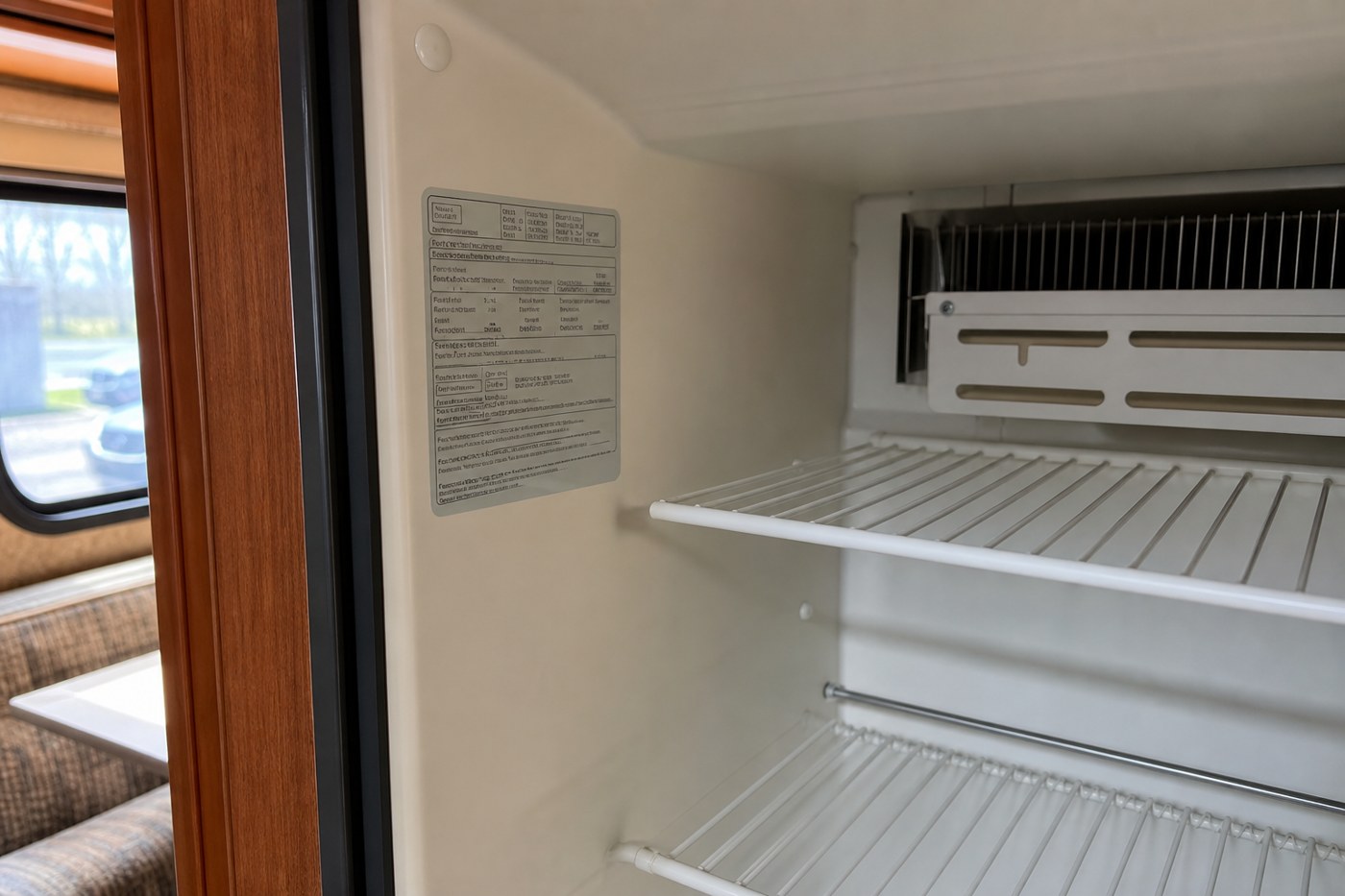
How an absorption fridge actually cools
Most RV refrigerators, including the Dometic and Norcold units installed in coaches for the last several decades, use absorption cooling rather than a compressor. Heat — from a propane flame or an electric heating element — drives a sealed mix of ammonia, water and hydrogen through a loop called the cooling unit. The heat boils the ammonia solution in a section called the boiler, the vapor separates and condenses, and the cycle pulls heat out of the fridge box as the fluid moves back through. Nothing pumps this around; it relies on gravity and pressure differences, which is why an absorption fridge needs to sit reasonably close to level to work.
Some newer Norcold and Dometic 12V models use a compressor instead — closer to how a home refrigerator or a car’s air conditioning works. These fail differently. Level doesn’t matter the same way, and the common failure points are electrical — a bad connection, a failed run capacitor, a control module — rather than a sealed cooling loop. The model and serial plate inside the fridge cabinet or on the back of the unit will usually tell you which type you have, and it’s worth checking that before you spend time chasing an absorption-fridge symptom on a compressor unit, or the other way around.
The failures we see most often
These are the failure points that come up most, roughly in the order we run into them.
- Control board or relay failure. Often shows up as a fridge that won’t turn on at all, or won’t switch between gas and electric modes even though power is reaching the unit.
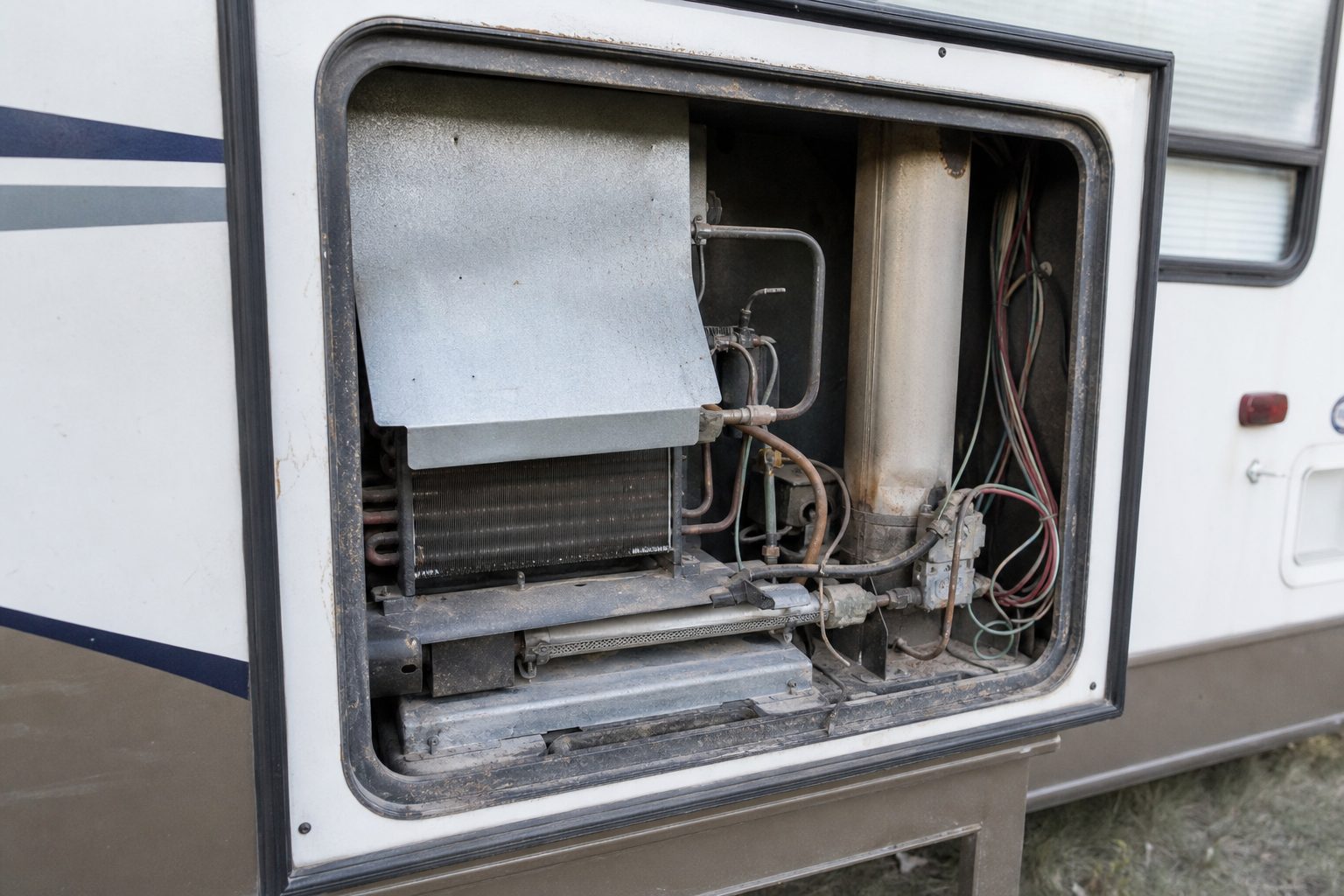
- Cooling-unit failure or an ammonia leak. Look for a sharp odor near the back of the fridge and yellow-green residue or powder around the boiler section. This is a sealed system — once it leaks, it’s done, though the cooling unit itself can sometimes be replaced separately from the rest of the fridge.
- Blocked burner, orifice or flue on the gas side. Soot, or a flame that’s weak, yellow or lazy instead of a steady blue, both point to a combustion or airflow problem rather than the cooling unit.
- A failed 120V heating element or its wiring. This only affects the electric side — a fridge that’s fine on propane but stays warm on shore power usually traces back here.
- 12V supply and grounding faults. The control board runs on 12V DC even when the fridge is plugged into shore power. A weak ground or a marginal connection can make the board behave erratically or not power up at all.
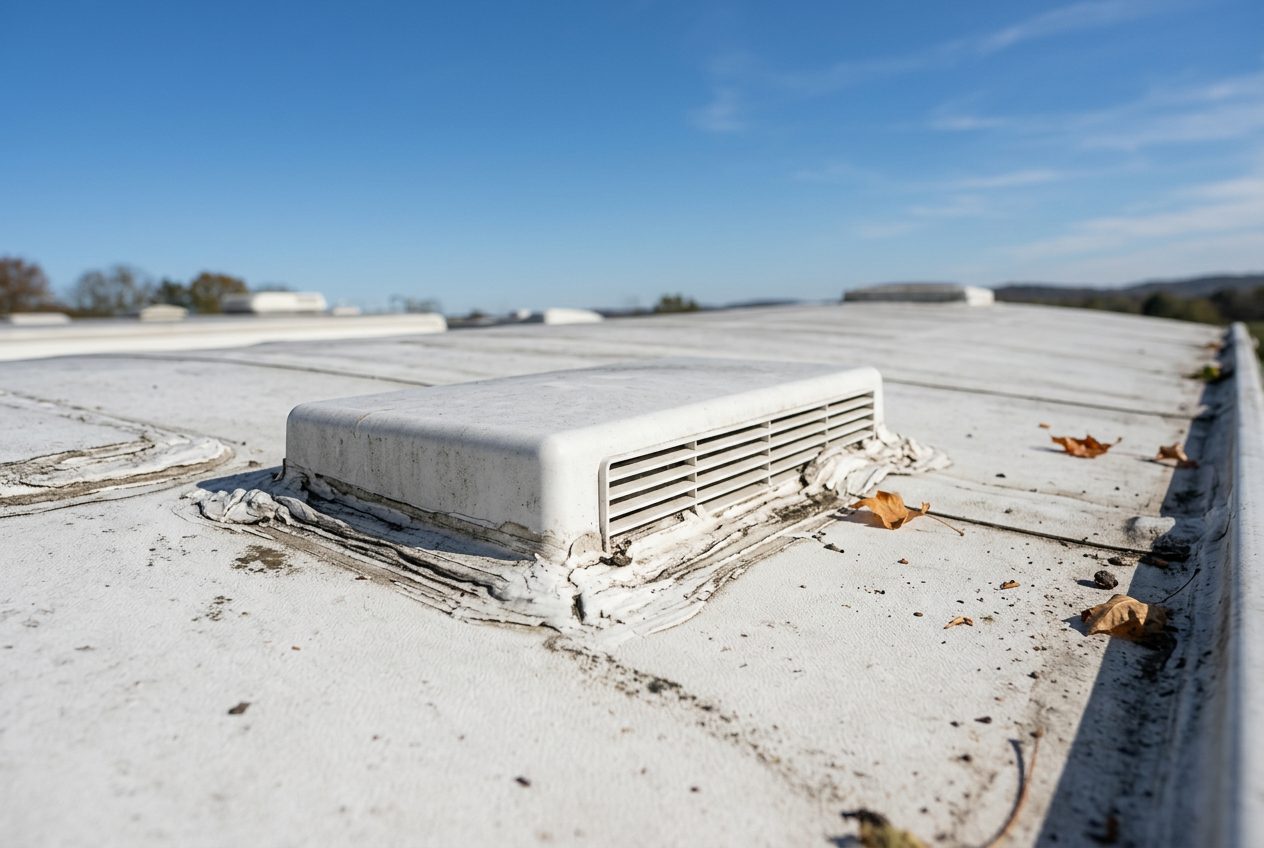
- Running out of level, or a blocked roof vent. Absorption cooling depends on gravity-fed flow inside the cooling unit. Parked with a real lean, or with the roof vent stacked with debris cutting off airflow, cooling suffers even when nothing is actually broken.
- A thermistor reading the wrong temperature. The thermistor sits on a fin inside the box. If it’s come loose or shifted position, the board can be running the fridge correctly while the display or cycle timing looks off.
The 12V and grounding checks above follow the same approach we use on how we diagnose 12V electrical faults elsewhere in a coach, and it’s worth reading about RV electrical grounding problems if this is the second or third system that’s acted up lately.
Safety: where to stop
Two of the items above are not DIY territory, and it’s worth stating that plainly.
If you smell ammonia near the fridge, stop using it and ventilate the space. That smell means the sealed cooling unit has failed, and ammonia is a genuine health hazard in an enclosed area. This isn’t a tighten-a-fitting repair — it’s a cooling-unit or fridge replacement.
Gas-side work on the burner, orifice or flue means working next to an open flame and a live propane line. If you’re not confident diagnosing it yourself, that’s the point to bring in someone who does this daily rather than working through it alone. The same caution applies to opening up the cooling unit itself — it’s a sealed, pressurized system, and forcing it open to “see what’s wrong” is how a repairable problem turns into a fridge that has to be replaced outright.
Send us photos of the back of the unit and the model plate and we’ll tell you what we’re looking at. Call (714) 847-0352 or schedule a visit.
Repair or replace: how to think about it
A warm fridge doesn’t automatically mean a new fridge. A few things change the math on repair versus replacement:
Whether the failure is in the cooling unit or in the controls. A control board, relay or gas valve is a component swap. A failed cooling unit is a bigger job, though on many units it is possible to replace just the cooling unit rather than the entire refrigerator — an option a lot of owners have never heard of.
Whether a replacement cooling unit is even still made for your specific model and generation. Older units can be harder to source parts for than current ones.
How the fridge is installed. A built-in unit set into cabinetry takes more labor to pull and reset than a straightforward swap, and that’s part of what makes one repair bigger than another.
The age and condition of the rest of the coach. On an older rig, it’s worth asking honestly whether this is the first system to need attention or one of several, rather than guessing from a symptom list alone. If a fridge repair turns out to be part of a bigger list, our RV repair services in Huntington Beach page covers what else we handle beyond refrigeration.
We don’t quote a price or a timeline without looking at the actual unit — too much depends on what we find once it’s open.
There’s also a simpler version of this decision that has nothing to do with the fridge itself: how much longer you plan to keep the coach. A cooling-unit replacement on a fridge you expect to use for years still makes sense even as a bigger job. The same repair on a coach you’re planning to sell or retire soon is a different conversation, and it’s a fair question to ask us directly rather than assume the answer.
Coastal Orange County note
Coaches stored near the coast see this pattern more than ones kept further inland. Salt air and the marine layer’s humidity are hard on any exposed electrical connection, and a refrigerator control board with wiring routed behind the unit isn’t protected from that any better than the rest of the coach’s 12V system. It’s one more reason a fridge that’s otherwise been reliable can start acting up after a season in a coastal storage yard.
If it’s the air conditioner giving you trouble instead of the fridge, see our guide if your air conditioner isn’t cooling — it’s a different system with different causes.
If you’ve worked through the gas-versus-electric check above and you’re still not sure what you’re looking at, send us photos of the back of the unit and the data plate. Call (714) 847-0352, or schedule a visit directly.
Frequently asked questions
Why is my RV fridge cold on electric but not on propane?
That split usually means the propane side has a problem the electric side doesn’t share — a blocked orifice, a weak flame, or an issue with the gas supply or regulator. It’s rarely the cooling unit itself, since a cooling-unit failure normally affects both modes at once. Check for a steady blue flame at the burner before assuming anything more serious is wrong.
What does an ammonia leak in an RV refrigerator smell like?
A cooling-unit ammonia leak has a sharp, biting smell, similar to strong cleaning ammonia but more concentrated, usually strongest right behind the fridge near the boiler section. You may also see yellow-green residue or a powdery deposit around that area. If you notice either, stop using the fridge and ventilate the space — this isn’t a repair to work through yourself.
Can just the cooling unit be replaced instead of the whole refrigerator?
Often it can. The cooling unit is a separate sealed component from the cabinet, controls and shelving, and replacing only that part is a smaller job than swapping the whole refrigerator. Whether a compatible cooling unit is still made for your model and generation is the deciding factor, and it is worth asking before you accept that a full replacement is the only option.
Does an RV refrigerator need to be level to work?
Yes, for absorption models. The cooling cycle relies on gravity to move fluid through the boiler and coils, so running noticeably out of level can reduce cooling and, over time, cause lasting damage. Newer 12V compressor models are less sensitive to this, so check your model plate if you’re not sure which type you have.
How long should an RV refrigerator take to get cold?
Give it several hours — most absorption units need eight to twelve hours to reach a safe temperature after being started cold, longer if it’s fully loaded or the weather is hot. If it’s been running most of a day with the door kept shut and it’s still warm, that’s when it’s worth working through the checks above rather than waiting longer.