An RV air conditioner that stops cooling turns any Southern California trip into a test of endurance. Whether you’re parked at Bolsa Chica, heading out to Joshua Tree, or living full-time in your rig near Huntington Beach, a functioning AC unit isn’t a luxury—it’s a necessity.
Orange County’s summer temperatures regularly push past 90°F inland, and even coastal campgrounds can trap heat inside a parked RV. When your rooftop unit starts blowing warm air, cycling on and off, or making strange noises, you need answers—not guesswork.
This guide walks you through the most common RV AC problems, step-by-step troubleshooting you can do yourself, and how to know when it’s time for professional RV AC repair at a trusted shop like Farace’s Automotive & RV Center in Huntington Beach.
Why RV Air Conditioners Struggle in Southern California
Heat Load Demands in Coastal and Inland Orange County
Southern California puts unique stress on RV air conditioning systems. Inland areas like Riverside and San Bernardino Counties can hit 100°F or higher during peak summer, forcing your AC to run near maximum capacity for hours at a stretch. Even along the Orange County coast, afternoon heat combined with direct sun on your RV’s roof pushes rooftop units harder than owners expect.
The thermal load on an RV is much greater than a house. Thin walls, large windows, minimal insulation, and a metal roof that absorbs solar radiation mean your AC unit has to overcome heat gain from every direction. A standard 13,500 BTU rooftop unit can struggle to maintain comfortable temperatures inside a 30-foot rig when exterior temps climb above 95°F.
Age-Related Wear on Rooftop AC Units
Most RV rooftop air conditioners are rated for 8 to 15 years of service life, but heavy use in warm climates shortens that window. Units manufactured by Dometic, Coleman, and Advent share common failure points: capacitors weaken, fan motors lose efficiency, and evaporator coils develop micro-leaks over time.
If your RV is more than 7 years old and the AC has never been serviced beyond filter cleaning, there’s a good chance internal components are running below their original efficiency. Reduced cooling output that slowly worsens over a season is the most common sign of age-related decline.
Electrical System Limitations
RV air conditioners draw significant power—typically 12 to 16 amps at 120V AC. If your electrical system can’t deliver consistent voltage, the compressor may not start, or it may cycle off prematurely on a safety cutoff.
This is especially common when running on a generator that’s undersized for your load, or when campground pedestals deliver low voltage during peak demand hours. Voltage below 108V can prevent the compressor from engaging entirely, while voltage sags cause the unit to short-cycle—running briefly, shutting off, and restarting repeatedly.
Common RV AC Problems and What Causes Them
RV AC Not Blowing Cold Air
This is the most common complaint. You turn the unit on, the fan runs, but the air coming out of the vents is warm or lukewarm. The usual causes include:
- Low or leaked refrigerant. RV AC units use sealed refrigerant systems. If the charge is low, the evaporator can’t absorb enough heat to cool the air. Unlike automotive AC, RV rooftop units aren’t designed for field recharging—low refrigerant almost always means a leak that needs professional diagnosis.
- Dirty evaporator or condenser coils. Dust, pollen, and road grime coat the coils over time, acting as insulation that blocks heat transfer. This is extremely common in RVs that travel frequently through dusty inland routes.
- Failed compressor. If the compressor doesn’t engage at all—listen for the click and hum when the unit cycles on—the system can’t circulate refrigerant. A failed run capacitor is the most frequent cause, not the compressor itself.
Weak Airflow or Uneven Cooling
If cold air reaches some vents but not others, or the airflow feels noticeably weaker than it used to, the issue is usually in the air distribution side:
- Clogged or collapsed return air filter. This is the number one cause of weak airflow. RV AC filters are small and clog quickly, especially in dusty environments.
- Blocked or disconnected ducting. In ducted systems, flexible ducting can kink, sag, or come loose behind ceiling panels. This sends cooled air into wall cavities instead of living spaces.
- Frozen evaporator coil. When airflow drops (from a dirty filter or low fan speed), the evaporator temperature can drop below freezing and ice up. Once frozen, airflow drops further and cooling stops. The fix is to turn off the AC, run the fan only to thaw the coil, then address the root cause.
AC Runs But Cycles On and Off Frequently
Short-cycling—the compressor turning on for a few minutes, shutting off, then restarting—indicates a problem with the electrical supply, thermal protection, or refrigerant charge:
- Low voltage from shore power or generator. Check your voltage with a multimeter at the pedestal. Anything below 108V will cause cycling.
- Overheating compressor. If the unit runs in direct sun without adequate airflow around the condenser, the compressor’s internal thermal protection will shut it down.
- Failing start capacitor. A weak capacitor can start the compressor but not sustain it, causing repeated short cycles.
Strange Noises or Vibrations from the Rooftop Unit
- Rattling or buzzing: Loose mounting hardware, a worn fan blade, or debris trapped in the condenser housing.
- Clicking without starting: Compressor trying to engage but failing—usually a capacitor or relay issue.
- Squealing: Fan motor bearing failure, which will eventually lead to a seized motor if not replaced.
- Humming with no fan: A locked rotor in the fan motor or a failed fan capacitor.
DIY Troubleshooting Steps Before Calling a Technician
Before scheduling a repair appointment, there are several checks you can safely perform yourself. These steps resolve a surprising number of RV AC complaints and can save you both time and money.
Check and Clean or Replace the Air Filter
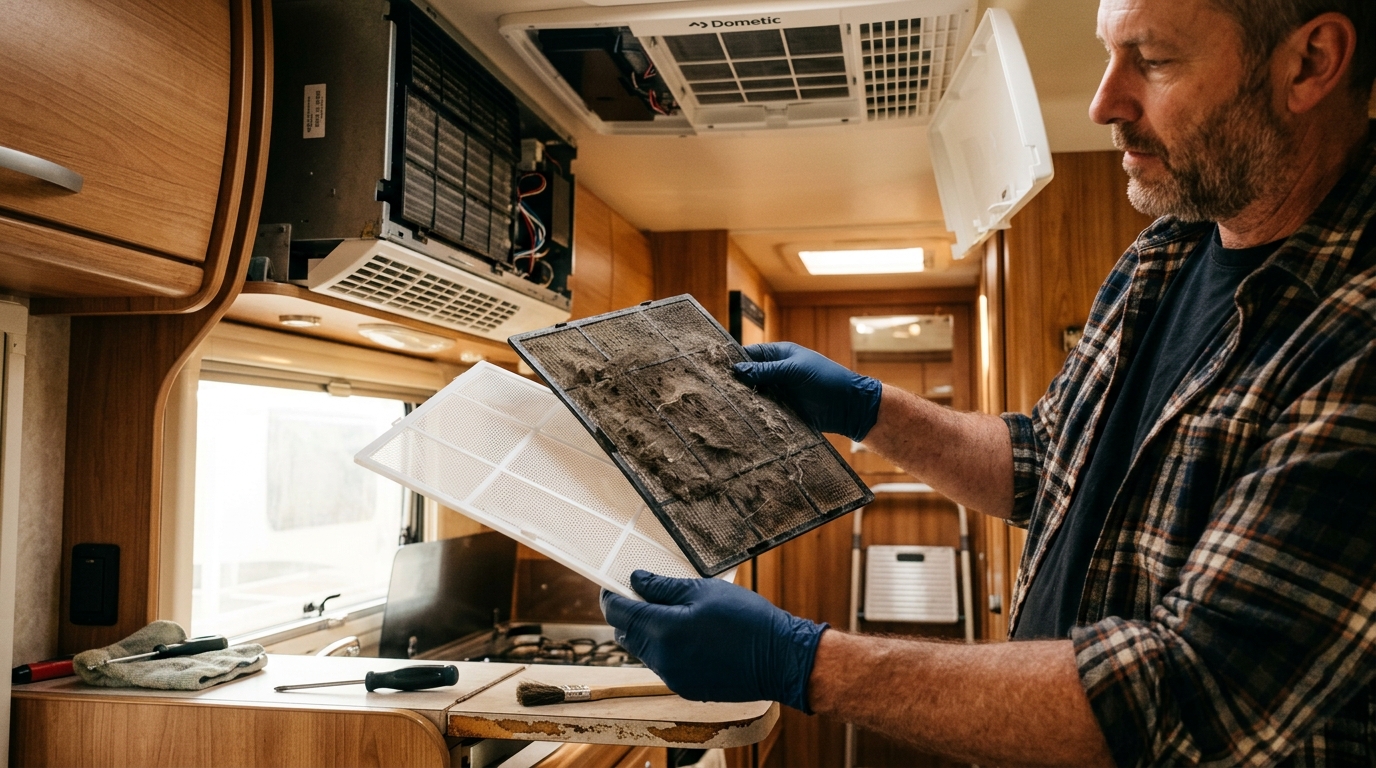
This should be your first move—always. Remove the interior ceiling assembly (it typically unsnaps or unscrews with two to four screws), pull the filter out, and inspect it. If it’s visibly dark with dust or restricted, clean it with warm soapy water, let it dry completely, and reinstall. If the foam is deteriorating, replace it.
A clean filter alone restores airflow in the majority of weak-cooling complaints. Make it a habit to check the filter every two weeks during heavy use and at the start of every trip.
Inspect the Condenser and Evaporator Coils
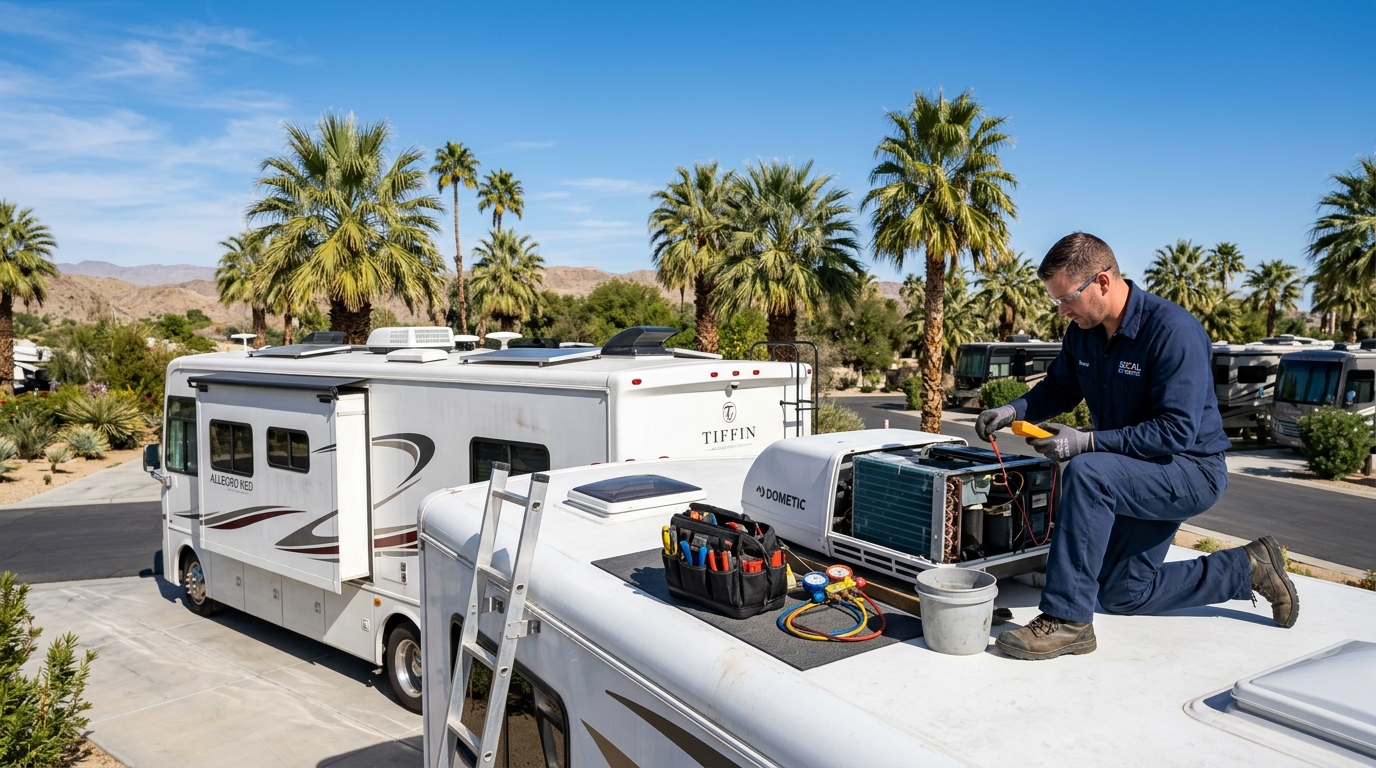
You’ll need to access the rooftop unit for the condenser coils. Remove the plastic shroud (typically 8 to 12 screws) and look at the coils. If they’re coated in dust, dirt, leaves, or cottonwood fluff, use a soft brush or compressed air to carefully clean them. Don’t use a pressure washer—the aluminum fins bend easily.
The evaporator coils are accessible from inside through the ceiling assembly. Check for ice buildup, visible dirt, or any signs of oil residue (which can indicate a refrigerant leak).
Test the Capacitor and Thermostat
If you’re comfortable with basic electrical work, you can test the start and run capacitors with a multimeter set to capacitance mode. A capacitor that reads more than 10% below its rated value is failing and should be replaced. Capacitors are the most commonly failed component in RV AC units and cost $15 to $40 for the part.
For the thermostat, verify it’s reading the correct temperature and that the set point is actually below the current interior temperature. Some digital thermostats lose calibration over time.
Verify Shore Power Voltage and Generator Output
Use a multimeter or plug-in voltage monitor to check the voltage at your power source. You want to see 115V to 125V. If you’re on a campground pedestal and reading below 110V, talk to the campground office—the pedestal may be overloaded.
If you’re running on your RV generator, make sure it’s rated to handle the AC’s startup surge (which can be 2 to 3 times the running amperage). An undersized generator will try to run the AC but can’t sustain it, leading to cycling or failure to start.
When to Schedule Professional RV AC Repair
Some RV AC problems are beyond safe DIY repair. Knowing when to call a professional prevents further damage and keeps you from voiding warranties or creating safety hazards.
Refrigerant Leaks and Sealed System Failures
If your coils are clean, airflow is good, the compressor runs, but the air still isn’t cold—the refrigerant charge is likely low. RV AC units use R-410A or the older R-22 refrigerant in sealed systems. Recharging requires EPA-certified equipment and technicians, and the leak must be found and repaired first, or you’ll lose the new charge within weeks.
A professional shop can pressure-test the system, locate the leak (often in coil joints or service valve connections), repair it, and recharge to the manufacturer’s specification. At Farace’s Automotive & RV Center, technicians handle sealed system repairs on all major RV AC brands including Dometic, Coleman-Mach, Advent, and Airxcel.
Compressor Replacement and Electrical Faults
A failed compressor is the most expensive single component in an RV AC unit. Replacement compressors run $300 to $700 for the part alone, plus labor. In many cases—especially on units older than 10 years—replacing the entire rooftop unit is more cost-effective than replacing just the compressor.
Electrical faults like burned contactors, melted wiring, or tripped internal thermal protectors also require professional diagnosis. These issues often point to an underlying problem (voltage irregularities, improper wiring, or a failing RV electrical system) that needs to be resolved at the source.
For a realistic breakdown of what these repairs typically cost in this area, check out our guide on RV repair costs in Huntington Beach.
Full Unit Replacement vs. Repair Cost Comparison
| Scenario | Estimated Cost | Recommendation |
|---|---|---|
| Capacitor replacement | $50–$150 | Repair |
| Fan motor replacement | $150–$350 | Repair |
| Refrigerant leak + recharge | $300–$600 | Repair if unit < 8 yrs |
| Compressor replacement | $500–$1,000+ | Replace if > 10 yrs |
| Full rooftop unit replacement | $800–$2,500 installed | Best for aging units |
If you’re facing a repair that costs more than half the price of a new unit, and your current unit is over 8 years old, replacement usually makes more financial sense. Newer units also run more efficiently and quieter—an important factor if you camp in Orange County parks with noise restrictions.
Keeping Your RV Cool Year-Round in Orange County
Seasonal Maintenance Schedule for RV AC
Preventive maintenance extends your AC’s life and catches small problems before they become expensive failures:
- Before every trip: Check and clean the air filter.
- Every 3 months (during use): Inspect condenser coils for debris, verify thermostat calibration, and test capacitors if you have a multimeter.
- Annually (spring): Full rooftop unit inspection—remove the shroud, clean both coil sets, check mounting bolts and gasket condition, inspect wiring connections, and lubricate fan motor bearings if applicable.
- Every 5 years: Have a professional evaluate the sealed system, check refrigerant levels, and assess compressor health.
For a broader maintenance framework, our guide on seasonal RV maintenance tips covers every system in your rig, not just AC.
Ventilation, Insulation, and Shade Strategies
Your AC doesn’t have to do all the heavy lifting. Simple strategies reduce the thermal load and help your unit maintain temperature more easily:
- Vent covers and roof fans. A powered roof vent (like a MaxxAir) pulls hot air out before it accumulates, reducing the load on your AC. See our RV ventilation tips for setup guidance.
- Reflective windshield and window covers. Blocking direct sunlight through your largest glass surfaces makes a measurable difference—up to 10°F cooler interior temps.
- Awning deployment. Extending your awning on the sun-facing side shades the wall and windows, reducing heat gain.
- Parking orientation. When possible, position your RV so the smallest surface faces the afternoon sun.
For RV owners who are preparing for extreme weather in SoCal’s hotter months, these strategies are just as important as the AC itself.
Your RV’s Comfort Starts With Reliable Service
A well-maintained RV air conditioner keeps you comfortable on California’s coast, in the desert, and everywhere in between. When your AC stops performing and troubleshooting doesn’t solve it—don’t wait for a heatwave to force the issue.
Farace’s Automotive & RV Center in Huntington Beach provides full RV AC diagnostics, repair, and replacement services for all makes and models.